MAKING A DIFFERENCE TO A SPECIES ON THE BRINK

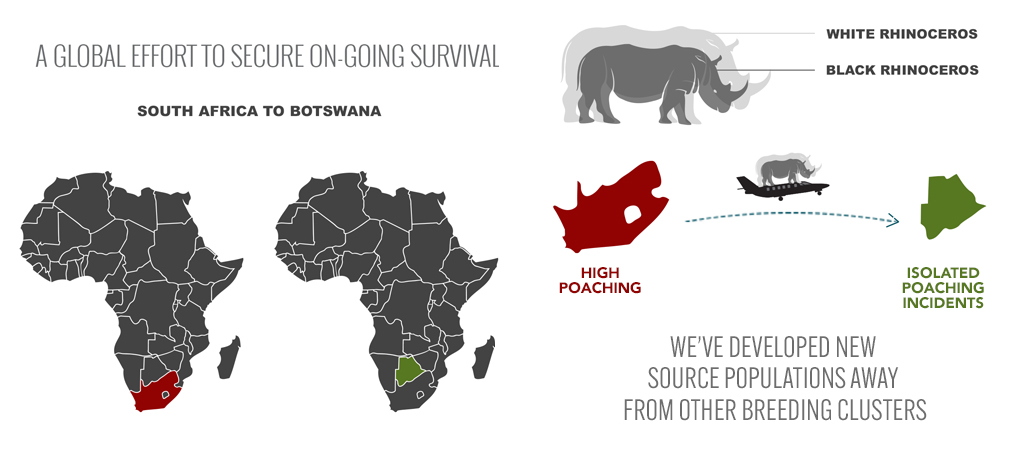
Faced with a devastating exponential rise in illegal rhino poaching in South Africa, Rhinos Beyond Borders was formed in order to start moving these endangered animals away from the poaching hotspots to create an additional source population.

Rhino poaching is at an all-time high in Africa and is spreading at an alarming rate. The illegal trade in rhino horn has seen the number of these magnificent creatures poached throughout Africa rise significantly in recent years. Since 2008, a disturbing 8 493 rhinos have been poached in South Africa alone. This total onslaught has led to the decline of many populations. With a rhino killed every twelve hours, more of these African icons are now being lost to poachers every year, than are being born.

Rhinos Beyond Borders is an initiative by Great Plains Conservation, a leading conservation and tourism company. The project aims to translocate rhinos from high-risk poaching areas in South Africa and create other source populations in Botswana’s wilderness areas.

Read More

Where appropriate, the rhinos are transported by air as opposed to road, in order to shorten the journey and lessen the amount of stress placed on the animals. The budget to translocate just one rhino is USD 50 000, with 25% of this amount exclusively set aside for the security and monitoring of the rhino in their new home for a period of three years. The whole project, including ongoing and monitoring and security, requires a total budget of USD 5 million.

Botswana was carefully selected as the recipient country due to its ecological suitability and the government’s commitment to the long-term success of this newly established rhino population. With the population from the translocated rhino now exceeding our original target of 100, our focus is now on maintaining the security and monitoring of these animals.

Rhinos Beyond Borders’ experienced monitoring teams on the ground and in the air, work daily with the Botswana Government, the Department of Wildlife & National Parks (DWNP), the Botswana Defence Force (BDF), the Rhino Conservation Botswana (RCB) team and other rhino conservation stakeholders to monitor the translocated rhino. The good news is that the incredible co-operative conservation effort from all the partners behind this project, has already resulted in the birth of a significant number of calves – an absolutely phenomenal achievement.

Rhinos Beyond Borders will continue to seek support for the security and monitoring of these translocated rhinos. The more funding we manage to generate, the more effective our dedicated support teams will be.

Great Plains Conservation was established to find the right formula of conservation, communities and commerce that would make a lasting, sustainable difference to the world’s iconic wildlife and wilderness areas.

Over the years we have witnessed the steady degradation of these natural treasures in spite of considerable efforts to protect them.

Our model takes stressed and threatened environments, surrounds them with compassionate protection and intelligent, sustainable management, and funds them with sensitive, low-volume, low-impact, tourism. Communities are an intrinsic part of this model and benefit directly from it. The final piece of the puzzle is our clients and guests – who pay to visit the camps we create, and through doing so, become our valued partners and agents of positive change.

Great Plains Conservation is first and foremost a conservation organisation that uses eco-tourism as a tool to sustain conservation programs.

Our philosophy is grounded in the fundamental appreciation of the good in life; good people, good staff, good decisions, good things we share and enjoy, but most of all we try to extend that “goodness” to our interactions with guests, with wildlife, with nature and with the local communities which so depend on them.

WWW.GREATPLAINSCONSERVATION.COM

General FAQs

What is Rhinos Beyond Borders?

Rhinos Beyond Borders (RBB) is a project of hope in which Great Plains Conservation is committed to translocating rhino from highly productive populations at risk, to wilderness areas in Botswana. The initial aim of the project was to create new viable breeding populations to broaden the Botswana Rhino gene pool, while also populating the ideal habitat for rhino and increasing the range, and in this way spreading the risk. The translocated rhinos have created a few source populations, and the significant number of calves are the true hallmark of a successful relocation. Rhinos Beyond Borders has exceeded its original goals, and the project’s focus is now on the active monitoring of these rhino.

Where are they moved to?

The rhinos have been placed in undisclosed Botswana locations selected by the Department of Wildlife and National Parks (DWNP). The criteria for release sites was established by the DWNP and confirmed in writing. The habitat, access, physical bomas for cows and calves, and monitoring ability post release, all formed part of the decision on the release sites. Although the animals’ movements are unhindered in this unique open system, and many have moved far away from the original release locations, we have kept tabs on these animals with our aerial and ground monitoring teams in support of the DWNP.

Why Bostwana?

Botswana remains some of the best white rhino habitat in the region and currently has one of the lowest poaching rates in Africa, partly thanks to a multi-departmental approach to conservation, in which conservation officials are supported by the Botswana Defence Force (BDF) and an official anti-poaching unit, with a shoot to kill policy, and political will from the top to help save rhinos.

Has this project not just attracted poaching to Botswana?

Poaching is likely to increase everywhere while there is demand for rhino horn: the illegal cartels involved in this trade have sources, and will develop sources where they see opportunity; however, thanks to the reasons outlined in the above answer, Botswana currently provides some of the best habitat for rhinos with a coordinated security system that is evolving in response to the increased threat.

Why Rhinos?

While rhino are only one of the species that is currently endangered through the risk of poaching, their numbers are being decimated particularly quickly. Not only do these animals have a vital role to play in the ecosystem, even more importantly, their extinction will open a precipitous gap in the natural balance. More immediately, if we cannot protect our iconic species in the system, we will be unable to protect the rest of the ecosystem.

With the loss of any of Africa’s iconic species, we risk disturbing the integrity of the entire ecosystem – like a jigsaw puzzle with missing pieces.

Why was it necessary to translocate the rhinos?

Great Plains Conservation believes that translocations are a fundamental way to secure the ongoing survival of an endangered species in that they spread the risk by creating multiple populations across a number of geographic locations, diversifying the gene pool and increasing the breeding rate. South Africa has many very successful and productive populations, and also some populations under immediate threat of poaching: both sources were used to supply the Project with rhinos for donation to Botswana

  • Rhinos were taken from existing, high-density and productive populations that were all under the threat of poaching, and released in a wilderness area with few numbers of rhinos and an established anti-poaching and monitoring system.
  • By creating multiple populations of rhino in a number of geographic regions, it is harder for poachers to operate than when there is one concentrated population in one country.
  • By moving the rhino to Botswana, we created a few new breeding nuclei for the species distributed across the vast Botswanan landscapes: as mentioned before, having more than one viable breeding population of rhinos helps to diversify their gene pool and increase their breeding rate.
  • Spreading the risk, and increasing the diversity of genes, are the most common reasons for translocation but, in this case, there was a third major reason: to stimulate the growth of the rhino populations in Botswana. Presently the country has low numbers of rhinos on a vast landscape of good habitat and it is sometimes difficult for mating pairs to even locate one another because of the vastness of the Rhino Habitat. In addition, it is a biological reality that the presence of new, younger males stimulates the females and this competition energises the males. All of this is much needed in any productive population.

What does this mean for the conservation of rhinos?

  • A story of hope for rhinos, Rhinos Beyond Borders sees private companies working with the governments of two countries to benefit conservation.
  • The success of the first phase of this innovative project has raised the profile of bilateral agreements between nations based on conservation.
  • It also creates awareness that private sector companies can have a marked impact on conservation issues by working with each other and the government and that conservation is much stronger when the private sector supports the government’s conservation actions.
  • It serves as a success story to stimulate new projects, where private sector operations join forces for conservation outcomes. While it is true that rhino conservation faces critical challenges at the moment, we aim to facilitate broader cooperation and believe many conservation situations can be changed if we work collaboratively.
  • On a purely practical level, the initiative is also helping to increase the number of rhino in Botswana, and the rate of calving is testimony to RBB’s success to date.